

Generative AI: How It Works, Real-World Use Cases & The Future of Intelligent Creation



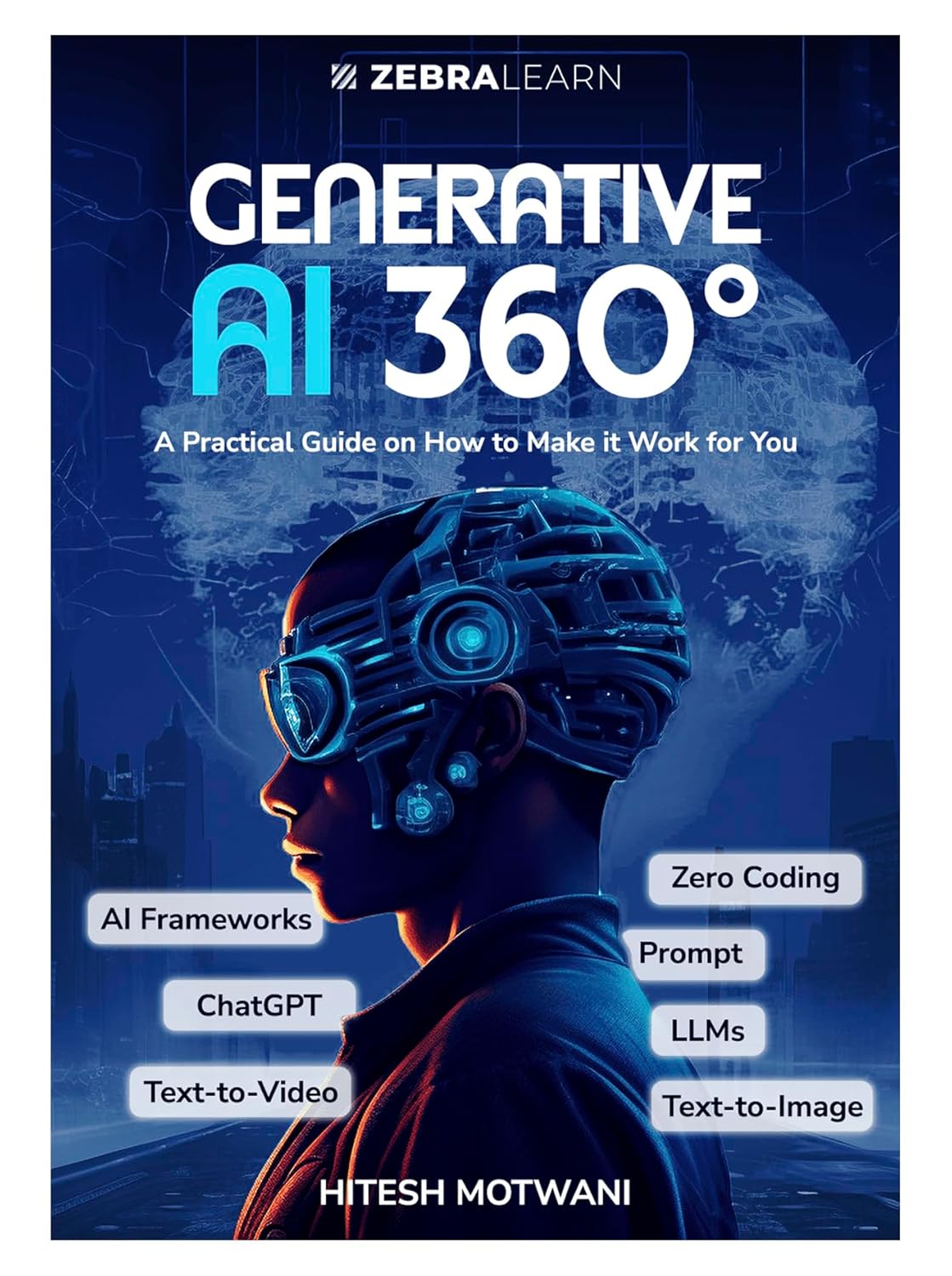
Generative AI 360°: Practical Guide to AI
Generative AI 360° is more than just a book—it's a visual, hands-on guide that turns AI beginners into workplace pros, with no tech skills needed. Packed with easy-to-understand visuals, step-by-step guides, and real-life examples, this book shows you how to use Generative AI tools to make your work easier and faster.
A few years ago, if you told someone that a computer could write a novel, compose a song, generate a photorealistic image of a place that does not exist, or write production-ready code from a plain English description — they would have called it science fiction. Today all of that is happening, and it is happening at a scale and speed that even the people building these systems did not fully anticipate.
Generative AI is not just another tech trend. It is a fundamental shift in what computers can do — moving from analyzing and classifying existing data to actually creating new content. In this guide we will break down exactly how it works, why it is different from traditional AI, what it is being used for right now, and what the honest conversation around its risks actually looks like.
What Is Generative AI — Really?
Most software you use every day follows explicit rules. A calculator does arithmetic. A spell checker looks up words in a dictionary. A search engine matches keywords. These systems are powerful but fundamentally passive — they process input and return a predetermined type of output based on rules someone programmed.
Generative AI works differently. Instead of following fixed rules, it learns patterns from enormous amounts of existing data — text, images, audio, code, video — and then uses those patterns to generate entirely new content that did not exist before. It is not retrieving or copying. It is synthesizing.
When you ask ChatGPT to explain quantum physics to a ten-year-old, it is not searching a database for a pre-written answer. It is constructing a response word by word, drawing on patterns learned from millions of texts, calibrated to the specific request you made. The output is genuinely new — generated in that moment, for that prompt.
Key distinction: Traditional AI recognises and classifies what already exists. Generative AI creates what does not yet exist — text, images, audio, video, code, and 3D models — by learning the underlying patterns of human-created content.
The Three Core Architectures Behind Generative AI
Not all generative AI works the same way under the hood. There are three main architectural approaches, each with different strengths:
1. Transformers — The Engine Behind Language Models
Transformers are the architecture behind GPT-4, Claude, Gemini, and most modern language models. Introduced by Google researchers in 2017, the transformer architecture uses a mechanism called self-attention — a way of understanding which words in a sentence are most relevant to each other, regardless of their distance apart.
When a language model processes the sentence "The trophy didn't fit in the suitcase because it was too big" — it needs to figure out that "it" refers to "the trophy," not "the suitcase." Self-attention is what allows the model to make that connection. Scale this up to billions of parameters trained on essentially the entire internet, and you get a model that can write essays, debug code, translate languages, and hold a coherent conversation.
2. Generative Adversarial Networks (GANs)
GANs were the dominant approach for AI image generation before diffusion models took over. They work by pitting two neural networks against each other — a generator that creates fake images, and a discriminator that tries to tell the fakes from real ones.
As training progresses, the generator gets better at fooling the discriminator, and the discriminator gets better at detecting fakes — a continuous competitive loop that drives both networks to improve. The result is a generator capable of producing photorealistic images of faces, objects, and scenes that never existed.
GANs are still used for specific applications — video generation, face synthesis, style transfer — but they are notoriously difficult to train and prone to instability.
3. Diffusion Models — How DALL·E and Stable Diffusion Work
Diffusion models are the technology behind Midjourney, DALL·E, and Stable Diffusion — the image generators most people use today. They work through a surprisingly elegant process:
During training, the model takes real images and progressively adds random noise to them — step by step — until the image is just random static. It then learns to reverse this process: given a noisy image, predict what the slightly less noisy version should look like. Do this enough times and you go from noise back to a coherent image.
At generation time, the model starts with pure noise and iteratively denoises it, guided by your text prompt, until a photorealistic image emerges. This is why AI image generation takes a few seconds rather than being instant — the model is literally running dozens of denoising steps.
How the Training Process Works
Understanding how generative AI is trained helps explain both its impressive capabilities and its very real limitations.
Step 1 — Data Collection at Massive Scale
Modern large language models are trained on datasets containing hundreds of billions to trillions of tokens (roughly words). The training data for GPT-4 and similar models includes web pages, books, academic papers, code repositories, Wikipedia, forums, and more — essentially a compressed representation of a large portion of human written knowledge up to a certain date.
Image models are trained on hundreds of millions of image-caption pairs — photos scraped from the internet paired with their descriptions, alt text, or surrounding text.
Step 2 — Learning Patterns Through Prediction
For language models, training works through a deceptively simple objective: predict the next word. Given "The cat sat on the" — what comes next? The model makes a prediction, checks it against the actual next word in the training data, measures the error, and adjusts millions of internal parameters to do better next time. Repeat this billions of times across trillions of examples and the model gradually develops a deep implicit understanding of language, facts, reasoning, and style.
Step 3 — Fine-Tuning and Alignment
Raw trained models are capable but unpredictable. They are then fine-tuned using Reinforcement Learning from Human Feedback (RLHF) — human raters evaluate model responses for helpfulness, harmlessness, and honesty, and those ratings are used to further train the model to produce better responses. This is what makes models like ChatGPT feel coherent and helpful rather than just statistically plausible.
Real-World Use Cases Right Now
Generative AI has moved far beyond the demo stage. Here is where it is being used at scale in real industries today:
Software Development
GitHub Copilot, powered by OpenAI, completes code as developers type — suggesting entire functions, generating boilerplate, and writing tests. Studies suggest it measurably increases developer productivity for repetitive tasks. Developers now routinely use AI to write first drafts of code that they then review, refine, and integrate.
Content and Marketing
Marketing teams use AI to generate ad copy variations at scale, write product descriptions for thousands of SKUs simultaneously, create social media content, and draft email campaigns. What previously took a team of writers weeks can now be produced in hours — though the best work still involves significant human editing and creative direction.
Healthcare and Drug Discovery
This is arguably the most consequential application. AI models are being used to predict protein structures, generate candidate molecules for new drugs, and simulate how compounds will interact with biological targets. DeepMind's AlphaFold solved the protein folding problem — a 50-year-old challenge in biology — and the resulting database has already been used in thousands of research projects globally.
Design and Creative Production
Designers use Midjourney and DALL·E for concept generation and mood boards. Film production companies use AI for storyboarding and VFX pre-visualization. Game studios generate environment textures and asset variations. In advertising, AI is already generating campaign visuals that go directly to production.
Education
AI tutors can explain concepts at different levels of complexity, answer follow-up questions, generate practice problems, and provide instant feedback. Khan Academy's Khanmigo, built on GPT-4, guides students through problems using the Socratic method rather than just giving answers.
Top Generative AI Tools in 2026
| Category | Tools | Best For |
|---|---|---|
| Text & Chat | ChatGPT, Claude, Gemini | Writing, coding, analysis, Q&A |
| Images | Midjourney, DALL·E 3, Stable Diffusion | Art, design, marketing visuals |
| Video | Sora, Runway ML, Pika Labs | Short video, VFX, animation |
| Music & Voice | Suno AI, ElevenLabs, Udio | Music generation, voice cloning |
| Code | GitHub Copilot, Cursor, Claude Code | Code completion, debugging, refactoring |
| 3D & Design | Spline AI, Canva AI, Adobe Firefly | UI design, 3D models, branding |
What Generative AI Is Not Good At
The hype around generative AI is real but so are its limitations — and understanding them makes you a more effective user of these tools.
- It hallucinate facts — language models confidently produce false information when they do not know something. They do not have a sense of uncertainty. Always verify factual claims from AI, especially dates, statistics, and citations.
- It has a knowledge cutoff — most models are trained on data up to a certain date and do not know about recent events unless given real-time search capabilities.
- It lacks genuine understanding — AI models are extremely sophisticated pattern matchers. They can produce text that looks like deep understanding without the underlying comprehension a human expert would have.
- It struggles with complex multi-step reasoning — while improving rapidly, AI still makes logical errors on problems that require careful step-by-step reasoning, especially in mathematics and formal logic.
The Ethical Challenges That Cannot Be Ignored
The same capabilities that make generative AI powerful create real risks that the technology industry, governments, and society are still working out how to address:
- Deepfakes and misinformation — AI can generate photorealistic images, audio, and video of people saying or doing things they never said or did. This is already being used to spread political misinformation and create non-consensual intimate imagery.
- Copyright and intellectual property — AI models are trained on copyrighted material. The legal questions around whether this constitutes infringement and who owns AI-generated content are still being litigated globally.
- Job displacement — creative professionals, writers, graphic designers, translators, and entry-level coders are already feeling the economic pressure. The transition will not be painless for everyone.
- Bias and discrimination — AI models inherit biases present in their training data. Without careful work to identify and mitigate these biases, AI systems can perpetuate and amplify existing social inequalities.
- Environmental cost — training large AI models requires enormous amounts of computing power and energy. The carbon footprint of AI development is a growing concern that the industry is beginning to take seriously.
The Future — What Is Actually Coming
Based on the current trajectory of research and development, here is what the next few years of generative AI looks like:
- Multimodal models getting stronger — models that understand and generate text, images, audio, and video simultaneously are already here (GPT-4o, Gemini Ultra). They will become dramatically more capable.
- Agents that take actions — AI that does not just generate content but takes real-world actions: browsing the web, writing and running code, managing files, booking appointments. This is already possible with current tools and will become mainstream.
- Personalisation at scale — AI that adapts to your specific writing style, knowledge level, and preferences over time, acting as a genuinely personalised assistant rather than a generic tool.
- Regulation and governance catching up — the EU AI Act is already law. More countries will follow with frameworks that require transparency, safety testing, and accountability for high-risk AI applications.
Final Thought
Generative AI is genuinely one of the most significant technological developments in decades — not because of the hype, but because it changes the economics of creation. Things that previously required significant skill, time, and resources can now be produced in seconds. That is not a small shift.
The right approach is neither uncritical enthusiasm nor reflexive fear. Understand what these tools can and cannot do. Use them where they genuinely help. Stay aware of the risks. And keep developing the human skills — critical thinking, judgment, creativity, domain expertise — that make you effective at directing and evaluating AI output, not just consuming it.
Curious about how a specific generative AI tool works or how to use it in your development workflow? Drop us a message on our contact page — we would love to help.
Generative AI 360°: Practical Guide to AI
Generative AI 360° is more than just a book—it's a visual, hands-on guide that turns AI beginners into workplace pros, with no tech skills needed. Packed with easy-to-understand visuals, step-by-step guides, and real-life examples, this book shows you how to use Generative AI tools to make your work easier and faster.
📚 You Might Also Like
- → Best Google AdSense Alternative 2026 - Monetag Review for Publishers miscellaneous
- → Top Java Interview Questions for 6+ Years Experience (2026) java
- → HTTP QUERY Method (RFC 10008) — The New HTTP Method Every Developer Should Know miscellaneous
- → How to Start Freelancing as a Web Developer in 2026 (Complete Beginner's Guide) miscellaneous
- → MyLync - Best Free Linktree Alternative for Developers, Creators & Businesses miscellaneous